
Development at Stations
The government is promoting the principle of increasing development at Rail Stations and other transport mode. This is a sensible objective. However, in practice the supporting policies may have unintended consequences.
Government Support for Development at Stations.
The Ministry of Housing has recently (18-11-2025) made a statement on Planning rules in relation to Stations.
Housebuilding near well-connected train stations will receive a default “yes” in future if they meet certain rules, ensuring more high-quality, affordable homes are built in and around our key towns and cities, saving commuters time and boosting access to housing.
Thousands more working families and commuters will be able to live and work near train stations thanks to this drive to speed up housebuilding, which will help connect people to towns and cities, and open the door to new job and education opportunities.
Housebuilders will be encouraged to build more homes near these transport links, and councils in England will also now be required to tell the government when they intend to reject new housing developments over a certain size, with the Housing Secretary able to have the final say on whether they should go ahead.
Recognising the significant benefits for jobs and growth that can be unlocked by building around train stations, these rules will extend to land within the Green Belt, continuing efforts to ensure that a designation designed in the middle of the last century is updated to work today.
The default “yes” will also apply equally across all local authorities, so that these benefits are seized across the country. The proposals will also include minimum housing density standards for these sites, expected to be exceeded in many cases, to make the most of sustainable growth opportunities for local housing, jobs, and businesses.
The Full Statement can be read here.
The statement is focused on housing and ignores the advantages of having accessible commercial sites near stations.
Supporting NPPF Changes Proposed
The revised National Policy Planning Framework (NPPF), which is currently under consultation, has detailed the policies that support development around stations. If the NPPF changes are adopted the changes include:
L3: Achieving appropriate densities
Para 3 Minimum densities for residential development proposals are appropriate in locations which provide high levels of connectivity to jobs and services. Where development proposals for housing or mixed-use schemes are within reasonable walking distance of a railway station, a density of at least 40 dwellings per hectare should be achieved within the net developable area of the site, or 50 dwellings per hectare where the station or stop is defined as ‘well-connected’
This statement is supplemented by two footnotes
For the purpose of this policy references to railway stations also includes stops on underground, tram and other light rail systems.
Well-connected rail stations and underground, tram and light rail stops are those in a top 60 Travel to Work Area located partially or fully within England by Gross Value Added (GVA) and which, in the normal weekday timetable, are served (or have a reasonable prospect of being served due to planned upgrades or through agreement with the rail operator) throughout the daytime by four trains or trams per hour overall, or two trains or trams per hour in any one direction.
GB3: Altering existing Green Belt boundaries
Para 1. Green Belt boundaries should be altered through the preparation and updating of local plans and where:
- This would enable the development of land around stations;
In principle and in the absence of other policies this means any station could have development around it within a reasonable walking distance.
Impact on Guildford
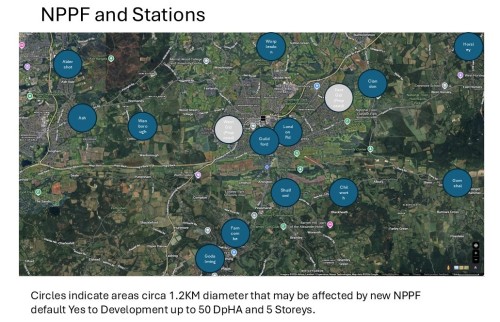
We have mapped 1KM circles approx. on all the planned and and existing rail stations to show very roughly where development might be allowed. Although some of the areas are acceptable there must be considerable concern at ill considered development at especially country stations. A current example is the development being proposed at Flexford by Taylor Wimpey which is adjacent to Wanborough Station. See Link
Down Load Image as PDF
Underutilised Asset
The Rail System is an underutilised asset around Guildford. The Rail Network is a transport network that, uniquely, has a measure of spare capacity, and that capacity could be improved and made more accessible with strategic investment. Having a regular and reliable services is critical.
Investment has recently been made to:
- improve signalling on the Portsmouth line, and North Downs Line. This improves saftey, increases reliability and in the case of the Portsmouth line allows for more services.
- new road bridge opened at Ash
- Finally the new rolling stock on the New Line via Effingham is being introduced..
Major improvements which have been discussed, all seem to be stalled at present, these include:
- Woking Flyover – which would improve reliability of services, and also create capacity of developments such as a rail link to Heathrow Airport.
- Heathrow Link, much talked about but no progress. The link is needed now rather than depend on the overloaded local road network which will face even more disruption in the Heathrow area if the 3rd Runway is built.
- The North Downs Line suffers from ageing rolling stock and limited services that provide a poor service to small stations such as Chilworth. The North Downs line will face increasing pressure due to the expansion of Gatwick Airport recently agreed. (Linked posts at foot of this article)
- Plans for new stations at Merrow and the Research Park/Royal Surrey County Hospital (RSCH) have not progressed,
Rail Stations are expensive.
Creating Rail Stations can be a complex and expensive business particulalry if conducted on a operational railway. An example of a simple station is the one curently being constructed in Balgary, near Glasgow, which has required signaling track and electrification changes. The two platform station has lifts and waiting shelters, access road and bike storage; and is built partially on an embankment. The project cost is £18.5M.
Against this, the cost of creating similar travel opportunities in the terms of expensive road changes etc needs to be evaluated.
Help us make Guildford better
We want our town to be vibrant, attractive and liveable. We support development that brings a sense of place and enhances the best aspects of our town. If such aims can be embraced, we believe Guildford has the chance to lead the way in enabling sensitive and sustainable development.
Pressures for development are increasing. Planning rules are being eased. The Society’s commitment to standing up for Guildford is needed more than ever.
Support Us
Getting involved allows the society to continue its work. We welcome new members, from every age and background. Membership provides an opportunity for you to contribute to the continued health of the town and surrounding area, and to meet other people who care about Guildford.