
Planning Committees ...
Download PDF [423 KB]
Since 2024, the English planning system has entered one of its most significant periods of reform since the post-war settlement of 1947. The changes do not amount to a wholesale adoption of continental European zoning, but they do mark a decisive shift away from a highly discretionary, case-by-case model toward a more plan-led, rules-based and spatially certain system. The result is a hybrid model: England remains formally discretionary, but increasingly borrows from continental planning traditions found in countries such as France, Germany and the Netherlands, where land-use rules, design parameters and infrastructure obligations are more clearly fixed at the plan stage. The direction of travel is therefore not “zoning” in a pure legal sense, but a gradual continentalisation of English planning practice.
The Guildford Society has attempted to summarise the changes in a lenghthy post that can be found here, and as a linked post of the foot of this post. We aim to modify this post as development occur.
Two key changes in the autmn are:
A) Revision on how Planning Committes
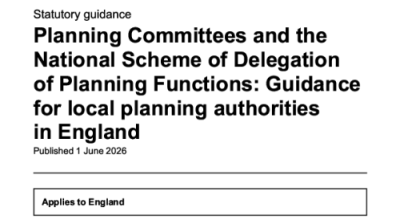
Planning Committees are being radically changed by the government. From Monday 2 November, chief planners will have significantly greater control over decision-making. The “overriding presumption” will be that applications are decided by officers, with committee determination used only by exception. The local authority chief planner will have the final say on whether an application is referred to committee. A key concern is that committees can only be effective where officers and members have a genuinely engaged and collaborative working relationship, enabling meaningful involvement of both the committee and the public in decision-making.
The government has issued Gateway Test criteria to help officers assess what may constitute a significant issue or matter in their area. Officers will need to consult the chair of the planning committee, or another nominated member, and may also engage more widely with councillors on their proposed approach.
(See Link to useful reseach article by Lichfields)
MHCLG Instructions on this matter are attached as a document at the foort of this post.
B) Adoption of National Development Management Policies
National Development Management Policies are one of the most significant important reforms introduced by the Levelling-up and Regeneration Act 2023 and developed through subsequent implementation work, NDMPs are intended to cover common planning issues that arise across England, such as heritage, flood risk, climate change, design, green belt, environmental protection and other development management principles. Where an NDMP conflicts with a local plan policy, the national policy is expected to prevail. It is anticipated that the NPPF 2026 will be published in final form in the autumn at which point the "National decision-making policies" in the NPPF will override the equivalent policies in the current Guildford Local Plan 2019 and Development Management Policies. How this is change is published is not yet clear either as a revised set of documents or addendums.
An example of a national decision-making policy taken from the draft NPPF is below:-
National decision-making policies
TC2: Development in town centres
1. In considering proposals for development in town centres, substantial weight should be given to the benefits of:
The society have used a series of sources to attempt to provide a summary of all the Planning changes This can be seen on the link below.
Help us make Guildford better
We want our town to be vibrant, attractive and liveable. We support development that brings a sense of place and enhances the best aspects of our town. If such aims can be embraced, we believe Guildford has the chance to lead the way in enabling sensitive and sustainable development.
Pressures for development are increasing. Planning rules are being eased. The Society’s commitment to standing up for Guildford is needed more than ever.
Support Us
Getting involved allows the society to continue its work. We welcome new members, from every age and background. Membership provides an opportunity for you to contribute to the continued health of the town and surrounding area, and to meet other people who care about Guildford.