Planning Committees ...
Download PDF [423 KB]
Since 2024, the English planning system has entered one of its most significant periods of reform since the current planning system was established in the late 1940’s. The changes do not amount to a wholesale adoption of a continental type zoning system, but they do mark a decisive shift away from a highly discretionary, case-by-case model, toward a more plan-led, rules-based and spatially certain system. This evolution is visible in the revised National Planning Policy Framework, and the implementation of reforms in the Levelling-up and Regeneration Act 2023, these include emergence of National Development Management Policies, faster local plan-making, statutory design coding, strategic planning reforms and a stronger infrastructure-first approach.
The result is a hybrid model: England remains formally discretionary but increasingly borrows from continental planning traditions found in countries such as France, Germany and the Netherlands, where land-use rules, design parameters and infrastructure obligations are more clearly fixed at the plan stage. The direction of travel is therefore not “zoning” in a pure legal sense, but a gradual adoption of continental practices into English planning practice.
The changes to the Planning System are inextricably linked to the intention of the government to reform Local Government and devolve powers to larger local government units.
It should be noted that many of these changes have been evolving or discussed for many years and that the 2024 onwards changes can be viewed as the current government giving greater urgency to devolution and improving the planning system partly as both these changes are claimed to aid economic growth and the provision of housing.
The practical consequence is that planning in England is becoming less about persuading decision-makers at the end of the process and more about shaping the rules at the beginning. The system is moving steadily toward a more rules-based, plan-led European type model. This has important implications for Local Residents on how plans are developed and developments consented in future.
The Society have used a series of sources to attempt to provide a summary of all the planning changes, this summary also provides links to government legislation and other sources that provide the detail. We also show how the English planning system relates to continental practice. The views expressed are those of the Society and carry no legal weight.
A PDF version of this post is available as a Download at foot of this post.
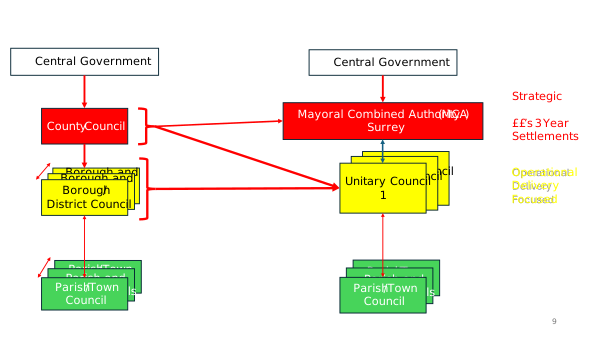
Changes to the Local Government System in England (Local Government Reorganisation (LGR)) will result in most council activities being transferred to Unitary Authorities with these clustered into a series of Mayoral Combined Authorities (MCA’s) that consist of a Elected Mayor and representatives of the underlying Unitary Authorities to handle a range of strategic matters including the production of Spatial Development Plans. The government has just announced a further round of creating unitary authorities see link.
Surrey is part of the way to implementing a new unitary structure.
2026
2027
The revised planning system interacts with the revised government structure at three levels.
National – greater emphasis on Strategic planning with the identification of Nationally Significant Infrastructure Projects.
Mayoral Combined Authority – Relates to overall national strategic planning via the production of Spatial Development Plans. The format of these is being refined at present but the longstanding London Strategic Plan is an example of what can be achieved.
Unitary Authority - Responsible for the development of a Local Plan compliant to the NPPF using a revised faster process. Development requests are then approved by the Unitary Authority
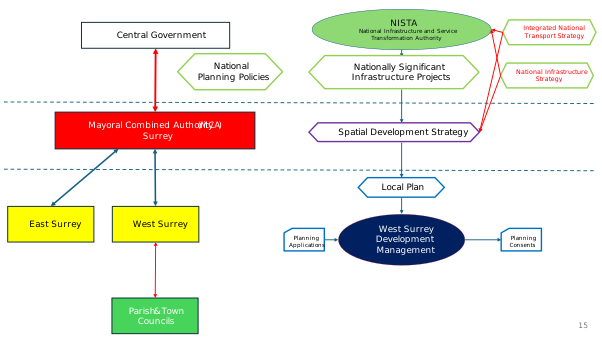
The Planning and Infrastructure reforms revive strategic planning across wider geographies. Spatial Development Strategies (See Link) are intended to address issues that individual local authorities cannot manage alone, including housing distribution, major employment growth, transport corridors, environmental networks and infrastructure investment. This marks a partial correction of the post-2010 abolition of regional spatial strategies, which left England reliant on fragmented local cooperation. Spatial Development Strategies are a key responsibility of the new Local Government Mayorial Combined Authorities with ultimately their elected mayor’s (See Link)
Continental systems generally treat planning as a multi-level activity: national objectives, regional spatial strategies, municipal zoning and site-level rules are expected to align. England is now building or rebuilding part of that architecture. The change is especially significant in high-pressure areas such as the Southeast, where housing need, transport capacity, green belt constraints and economic growth cannot be sensibly resolved at borough level alone.
Another continental feature is the growing emphasis on infrastructure-first planning. English planning has often relied on Section106 agreements and the Community Infrastructure Levy (CIL) to mitigate the impacts of individual schemes after sites have already been allocated or permitted. By contrast, continental practice more often integrates transport, utilities, schools, health facilities, green infrastructure and public realm into the planning framework before development is consented.
The English reforms attempt to move in that direction by linking local plans, strategic plans, infrastructure delivery strategies, development corporations and infrastructure consenting more closely. The Planning and Infrastructure Act 2025 strengthens this delivery orientation by aiming to accelerate major infrastructure, streamline consenting, reduce delay and support large-scale housing growth. This is not simply an administrative reform; it changes the purpose of planning from controlling individual applications to organising growth.
The draft NPPF 2026 emphasises infrastructure-first planning. The Spatial Development Strategies developed by the MCA’s are a key component of this process
The incoming Labour Government published the revised National Planning Policy Framework (NPPF) in December 2024. This signalled a clear change in tone. It restored a stronger emphasis on housing delivery (Supporting the government’s desire to build 1.5M Homes), introduced the concept of Greybelt, and reintroduced a more directive approach to assessing housing need (via the implementation of the Standard Method), and placed renewed pressure on local planning authorities to maintain up-to-date plans.
A new NPPF 2026 is due to be implemented in the autumn of 2026 following consultation in early 2026 (See Link) The NPPF 2026 did not alter the substance of that framework but confirmed the Government’s intention to make national policy more operational and less merely advisory, this includes the use of standardised National Development Management Policies (See next Section).
The draft NPPF 2026 also proposes several key changes:
Many of these proposed changes strengthen the power of the Local Plan to codify and drive development. This continues the trend evident since 2024 to put more weight on whether a proposal complies with fixed rules, developed or altered during a plan making process by strengthening national policy, reducing local variation and increasing the importance of conformity with plan-led expectations.
A subtle change in planning is that Local Plans produced through the new process won’t recognise the concept of Supplementary Planning Documents (SPDs). SPDs cannot now be implemented with the last date for adoption being 30 June 2026. The assumption is that SPD’s will be written as far as is practical into new Local Plans.
There is the concept of Supplementary Plans that might be used for large sites. Supplementary plans will form part of the development plan and have the same weight as a local plan for the purposes of decision-making; they are thus far more powerful than a SPD.
Details relating to a Supplementary Plan, including anticipated dates for preparation, consultation and adoption must be included in the local plan timetable. The timetable must also be prepared and published if the supplementary plan preparation precedes preparation of a local plan.
National Development Management Policies are one of the most significant important reforms introduced by the Levelling-up and Regeneration Act 2023 and developed through subsequent implementation work, NDMPs are intended to cover common planning issues that arise across England, such as heritage, flood risk, climate change, design, green belt, environmental protection and other development management principles. Where an NDMP conflicts with a local plan policy, the national policy is expected to prevail. It is anticipated that the NPPF 2026 will be published in final form in the autumn at which point the "National decision-making policies" in the NPPF will override the equivalent policies in the current Guildford Local Plan 2019 and Development Management Policies. How this is change is published is not yet clear either as a revised set of documents or addendums.
An example of a national decision-making policy taken from the draft NPPF is below:-
National decision-making policies
TC2: Development in town centres
1. In considering proposals for development in town centres, substantial weight should be given to the benefits of:
This is change is distinctly continental in character. France operates within a strong national urbanism code; Germany combines federal planning law with binding municipal land-use plans; and the Netherlands has long used national and municipal spatial frameworks to define development rights more clearly in advance. NDMPs do not create a full code-based system, but they move England toward a national layer of rules that constrains local discretion and reduces repetitive local policymaking; at present there are circa 300 English Local Planning Authorities.
The Draft NPPF makes heavy reference to the Design and Placemaking Planning and Practice Guidance document also issued as a draft in early 2026. This combines the previously published
with some changes.
The draft Design and Placemaking Planning and Practice Guidance document can be seen at this link.
The Design and Placemaking PPG in its introduction states
“The principles for design quality are long standing: buildings and places should be fit for purpose, durable and bring delight. Places function well by accommodating homes, businesses and a range of other uses and activities that support everyday life. Places are complex and evolve, shaped by buildings, streets, landscape and infrastructure. Incremental changes affect their quality, but well‑designed places endure.”
The guidance consists of three parts.
The draft Design and Placemaking Planning and Practice Guidance document can be seen at this link XXXXXX
The Design and Placemaking PPG provides the support for Design coding that is one of the clearest examples of England adopting continental-style planning practice. Historically, design quality in England has often been negotiated at application stage through design and access statements, design guides, officer judgement and committee debate. The new approach seeks to define design expectations earlier and more precisely, through area-wide or site-specific codes that can shape height, massing, street layout, materials, public realm, density and character.
This resembles Dutch (beeldkwaliteitsplannen), German (Bebauungspläne) and French (Plan local d’urbanisme) provisions, all of which can prescribe the physical form of development in advance. The English version is still more flexible, but the direction is unmistakable: design is being shifted from an uncertain negotiation to a rule-based framework. That is a profound cultural change for developers, councillors and communities alike.
The Government has committed to a faster and clearer process, with a 30-month timetable for preparing and adopting local plans. This responds to a long-standing weakness of the English system: many plans have taken years to produce, have become out of date before adoption, or have left authorities vulnerable to speculative applications and appeal-led development.
Local Plans have also expanded in that they now include the Development Management Policies, either national or local, within the Local plan. The two documents Local Plan Sites and Development Management Policies become one.
The Local Plan Process covers the following steps.
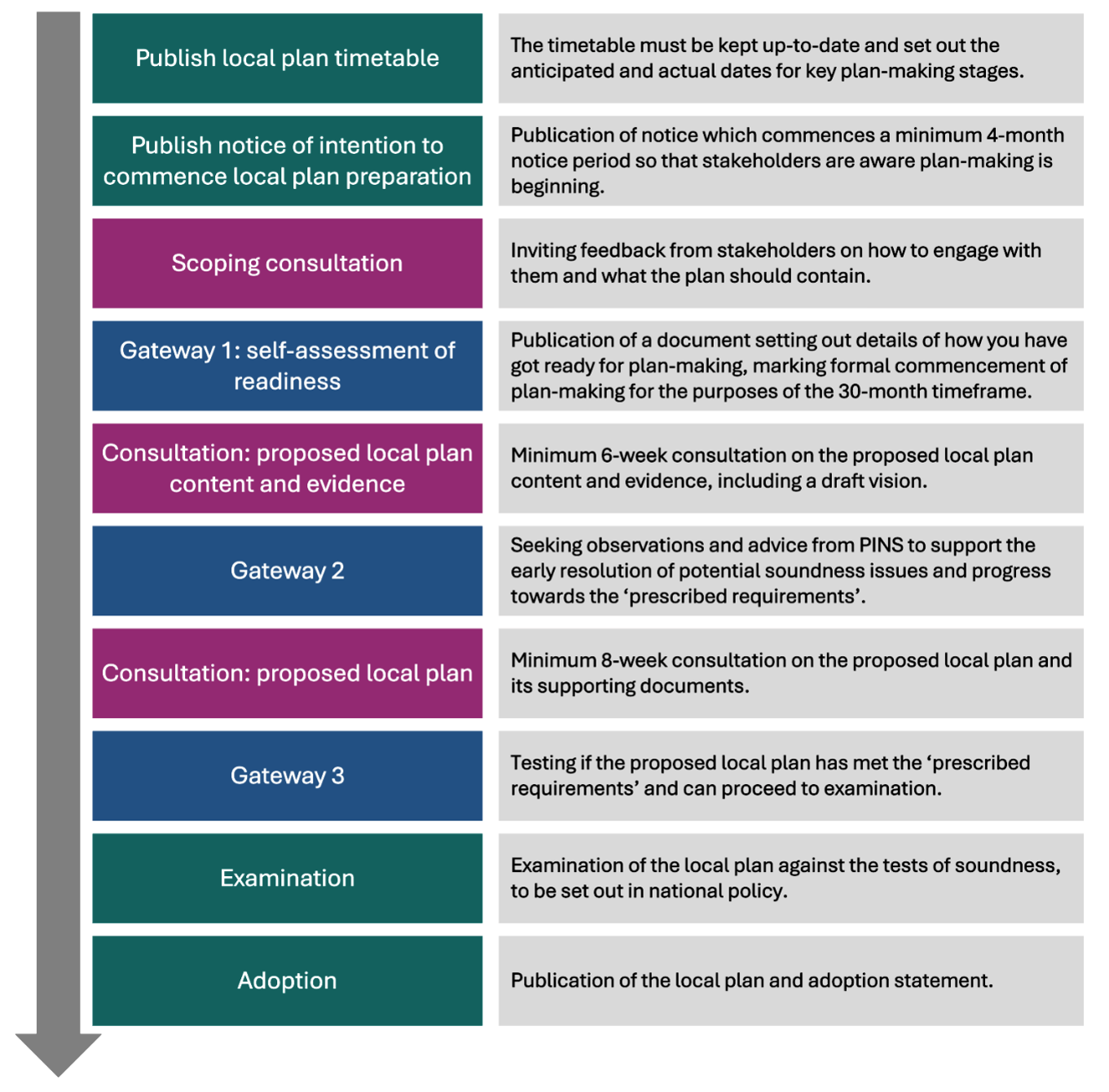
MHCLG have produced a useful summary of each stage see more details at this link
The detailed timing of the production of the Guildford Local Plan can be found at this link
The continental comparison is again clear. In Germany and the Netherlands, the plan is not simply a policy document but the central regulatory instrument through which land-use certainty is created. England’s new local plans are expected to be shorter, more spatial, less repetitive and more focused on allocating land, defining place-based outcomes and setting clear delivery expectations. This makes the local plan more like a spatial contract between the state, developers and communities.
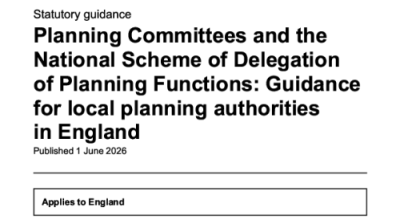
Planning Committees are being radically changed by the government. From Monday 2 November, chief planners will have significantly greater control over decision-making. The “overriding presumption” will be that applications are decided by officers, with committee determination used only by exception. The local authority chief planner will have the final say on whether an application is referred to committee. A key concern is that committees can only be effective where officers and members have a genuinely engaged and collaborative working relationship, enabling meaningful involvement of both the committee and the public in decision-making.
The government has issued Gateway Test criteria to help officers assess what may constitute a significant issue or matter in their area. Officers will need to consult the chair of the planning committee, or another nominated member, and may also engage more widely with councillors on their proposed approach.
At a recent planning conference, concerns were raised about the additional pressure the national scheme of delegation may place on nominated officers, particularly through discussions with councillors and public scrutiny of who ultimately made the planning decision.
(See Link to useful reseach article by Lichfields)
MHCLG Instructions on this matter are atteched as a document at the foot of this post.
For places such as Surrey and Guildford, the reforms are likely to make the next generation of plans more consequential. Large sites such as urban extensions, regeneration areas and strategic employment locations will increasingly be shaped through masterplans, infrastructure schedules and design codes rather than negotiated afresh through each planning application. This will require greater detail to be included in Local Plans with sites maybe detailed to a level that has been seen in the Strategic Sites SPD. This could produce greater certainty, but it may also reduce the scope for local political discretion once the plan has been adopted.
The Local Government Reorganisation also places more pressure on the this planning system with potentially key staff changing, roles and responsibilities changing and key elements e.g. Spatial Plans having to await the formation of the Mayoral Combined Authority.
Communities need to engage earlier in the process, because the decisive debates will increasingly occur at plan-making stage rather than at application stage. Creating effective engagement in the plan-making process will be critical. Developers, meanwhile, will face a clearer but potentially stricter rulebook: where a proposal accords with the plan and design code, it may be harder for local authorities to resist; where it does not, the route to permission may become more difficult. It is possible that although plans for particular sites will settled as regard to density etc. that debate will shift to the application of design codes and the overall quality of design. The balance of power shifts from ad hoc negotiation toward front-loaded spatial planning.
The evolution of the English planning system since 2024 is best described as a move toward a hybrid English-continental settlement. England is not abandoning discretion, nor is it adopting full zoning. But it is clearly seeking more certainty, more national consistency, faster plan-making, stronger design control, strategic spatial coordination and infrastructure-led delivery. These are all hallmarks of continental planning practice.
The continental influence can be seen in five main ways:
However, England is not becoming Germany, France or the Netherlands as there is:
The English model is therefore best understood as a discretionary system being overlaid with continental-style rules.
The practical consequence is that planning in England is becoming less about persuading decision-makers at the end of the process and more about shaping the rules at the beginning; development rights, design expectations and infrastructure obligations should be increasingly being settled in advance during plan making. The system remains recognisably English, but its centre of gravity is moving steadily toward a more rules-based, plan-led European model.
A critical issue is how these changes are explained to local populations, already disengaged from Local Politics and Planning. The government has, up to now been spectacularly poor, in explaining and including the public into the debate about planning changes.
English Planning System Changes in 2026
View article Design and Placemaking Guidance View article The Ministry of Housing Communities and Local Government (MHCLG) has issued a draft Design and Placemaking Planning Practice Guidance (PPG) document that intended to support the support the application of policies in the draft National Planning ... View articleHelp us make Guildford better
We want our town to be vibrant, attractive and liveable. We support development that brings a sense of place and enhances the best aspects of our town. If such aims can be embraced, we believe Guildford has the chance to lead the way in enabling sensitive and sustainable development.
Pressures for development are increasing. Planning rules are being eased. The Society’s commitment to standing up for Guildford is needed more than ever.
Support Us
Getting involved allows the society to continue its work. We welcome new members, from every age and background. Membership provides an opportunity for you to contribute to the continued health of the town and surrounding area, and to meet other people who care about Guildford.